
research
Physical principles of programmable self-assembly
Self-assembly underlies the mystery of life, forms the foundation of biology, and holds near-infinite potential as a technological tool. The basic premise is simple: building blocks autonomously come together to form nanoscale materials and machines. But to control self-assembly, we must understand how the tunable design attributes of those building blocks give rise to the desired functional properties of the assembled structures. Establishing this connection is a daunting task, and our best efforts at self-assembly pale in comparison to the capabilities of biology.
My research tackles this problem from the ground up, aiming to uncover the fundamental principles, limitations, and trade-offs inherent to the physics of self-assembly. The ultimate goal is a deeper understanding of how these physical principles shape biology and enable designer nanotechnology. My approach starts from first principles by combining statistical mechanics, convex geometry, and combinatorics. I use analytical methods to map out the mathematical structure of self-assembly’s high-dimensional design spaces and then navigate them with modern numerical methods, leveraging automatic differentiation and convex optimization as critical tools. Through it all, my focus remains on cultivating an intuitive picture of the underlying physics, which ultimately informs and facilitates clean and controlled numerical treatment.
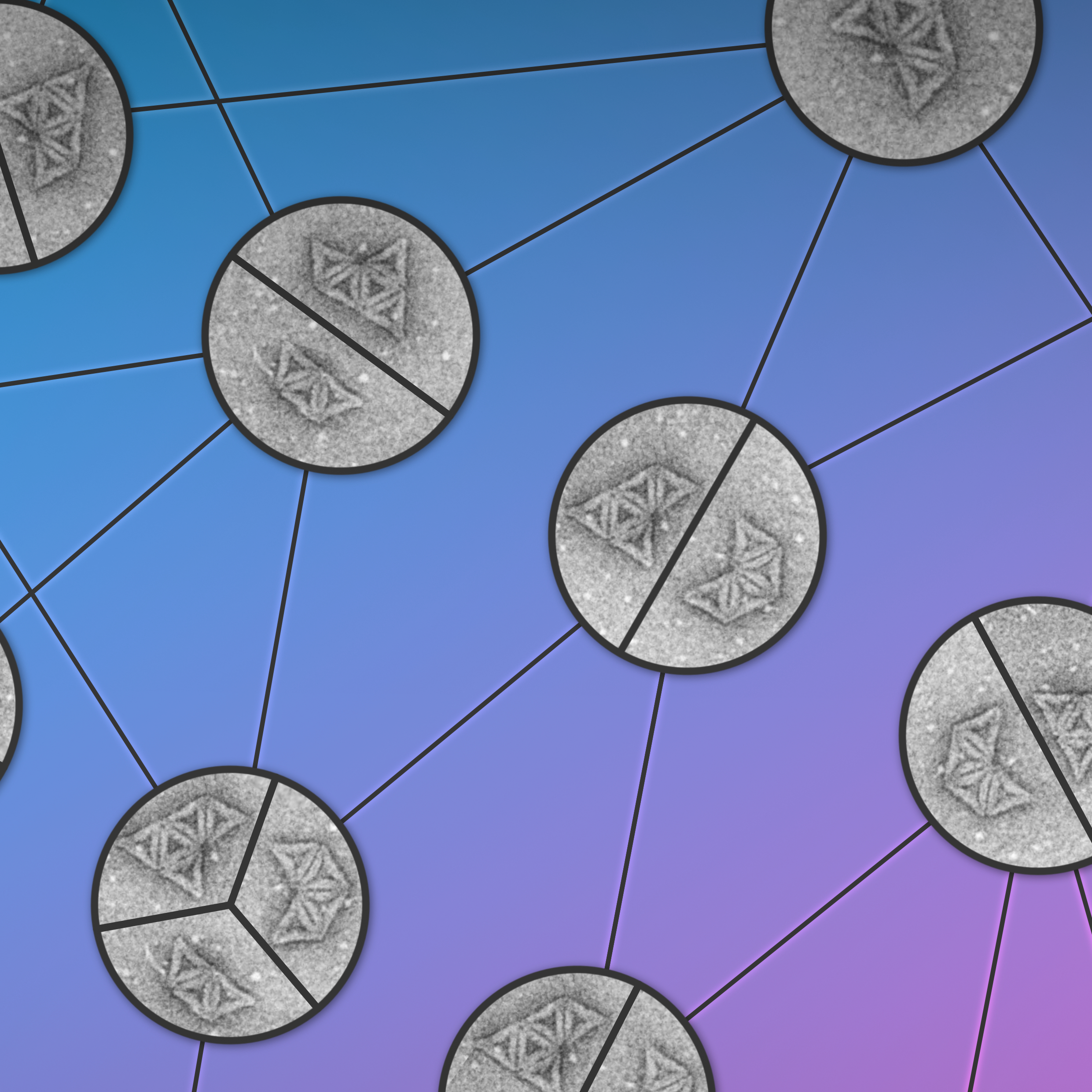
Related publications:
- MC Hübl and CP Goodrich. Entropic size control of self-assembled filaments. Phys. Rev. Research 8, L012054 (2026).
- MC Hübl and CP Goodrich. Simultaneous optimization of assembly time and yield in programmable self-assembly. J. Chem. Phys. 164, 084904 (2026).
- MC Hübl, TE Videbæk, D Hayakawa, WB Rogers, and CP Goodrich. A polyhedral structure controls programmable self-assembly. Nature Physics 22 (2), 294-301 (2026).
- MC Hübl and CP Goodrich. Accessing semiaddressable self-assembly with efficient structure enumeration. Phys. Rev. Lett. 134, 058204 (2025).